The sound
The Portuguese guitar and the viola
The two instruments behind fado: the twelve-string Portuguese guitar and the acoustic viola, how the Lisbon and Coimbra guitars differ and what to listen for.
Book the Noble Hall concert ↗Quick answer
The guitarra portuguesa is a plucked instrument that carries twelve metal strings in pairs, and it is the sound people link to fado above any other. It normally plays beside the viola, an acoustic guitar. Lisbon's guitar is pitched at D and rings brighter, while Coimbra's is pitched at C and sounds darker. A concert with a singer and guitarists, like the Noble Hall hour, is built around them.
The Portuguese guitar
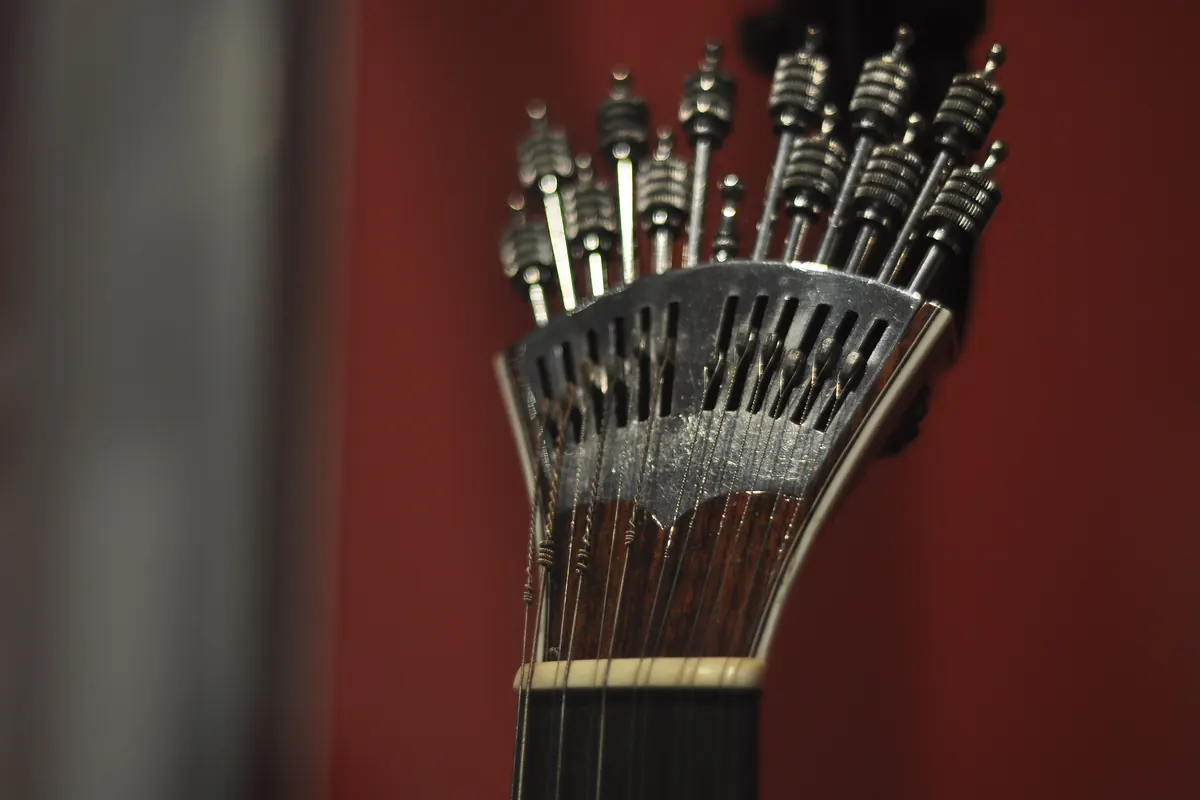
According to Wikipedia the guitarra portuguesa carries twelve metal strings, doubled into six courses. UNESCO's entry calls it a pear-shaped cittern, strung with twelve wires and found only in Portugal. It keeps old-style watch-key tuners, which few instruments still use, and fado is the music it is most tied to. The photograph beside this section shows that tuning mechanism up close, which is why it looks more like a small machine than a guitar head.
Where it comes from
Wikipedia traces the instrument back to the medieval citole, with signs of use in Portugal from the thirteenth century, and names the cittern as its direct ancestor, pointing to a carving of about 1680 at the Alcobaça Monastery. About 1750 a type of cittern, the English guitar, arrived in Portugal, and Portuguese makers later reworked it. They widened the body, lengthened the scale and broadened the fingerboard. The result is Portuguese in its details, whatever its ancestry.
Lisbon and Coimbra guitars
Each city has its own model. Wikipedia gives the free string length as about 445 millimetres for Lisbon and about 470 for Coimbra. The Lisbon model has the broader soundboard and a snail-shaped scroll at the head, the caracol, while Coimbra's carries a teardrop-shaped ornament, the lágrima. The Lisbon neck is usually shorter and narrower, and the Coimbra guitar is generally the simpler one to build. In sound, Lisbon's is brighter and more resonant and Coimbra's is darker.
Two tunings
The usual tuning is called afinação do fado, fado tuning. It is set to D in Lisbon and to C in Coimbra, a major second apart, and Coimbra players keep the Lisbon note names, so a note that sounds as C is called D. Wikipedia adds that a natural tuning inherited from the English guitar stayed common until the early twentieth century and has mostly disappeared. What you will notice in the room is simpler: the Coimbra guitar sits lower and sounds darker.
The viola
Wikipedia says both fado styles pair the guitarra with the viola, and calls the viola a type of guitar. UNESCO describes the traditional backing as a wire-strung acoustic guitar beside the Portuguese guitar, and says that recent decades have added a second Portuguese guitar and a bass to some line-ups. The pair is still the usual backing: the Portuguese guitar above and the viola beneath it.
How the guitar plays with the voice
In Lisbon fado, Wikipedia says, the guitarist plays the introduction and then alternates short phrases with the singer in call and response. In faster pieces the guitar often improvises with great skill. In Coimbra fado the Portuguese guitar plays chords alongside an acoustic guitar and does not answer the singer's phrases. Listening for the call and response is the quickest way to hear what is distinctive about the Lisbon way of playing.
What to listen for in the hall
Start with the introduction, when the guitar sets the key and the mood before the singer enters. Then follow the exchange between voice and guitar, phrase by phrase. Notice the held note at the end of a line, the rubato that Wikipedia describes. The singer explains fado and its instruments between songs, so the hall itself will point out many of these things.
Who this isn't for
None of this is a lesson. The Noble Hall hour is a concert with spoken explanations, not a workshop, and nobody there will teach you to play. If you want to see a Portuguese guitar made, to try one or to study its history in depth, a guitar maker's workshop or a museum devoted to the instrument is the right place. The concert is also closed to wheelchair users, so check access first.
Frequently asked questions
How many strings does the guitarra carry?
Twelve, in six doubled courses, according to Wikipedia.
What is the viola in fado?
An acoustic guitar that accompanies the Portuguese guitar. Wikipedia describes it as a type of guitar.
How do the two city guitars differ?
Lisbon's is pitched at D and sounds brighter. Coimbra's sits a major second lower, at C, and sounds darker.
Where does the Portuguese guitar come from?
Wikipedia traces it to the medieval citole and the cittern, and says the English guitar reached Portugal around 1750 and was reworked.
Can a classical guitar stand in for it?
No. The guitarra has twelve strings in pairs, a pear-shaped body and watch-key tuners, while a classical guitar has six strings.
Sources